
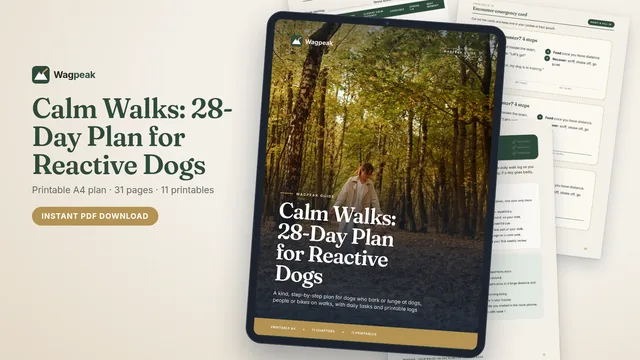
Calm Walks: a 28-day reactive dog training plan for calmer walks
A day-by-day plan for walks with a dog who barks or lunges at dogs, people or bikes: threshold zones, routes, core exercises, 11 printables.
$9
📄 Includes an English and a Norwegian version
⚡ Digital PDF · instant download · nothing is shipped
🔒 Secure checkout on Gumroad
What's inside
- Why reactivity happens, early stress signals, green/yellow/red zones and your dog's threshold distance
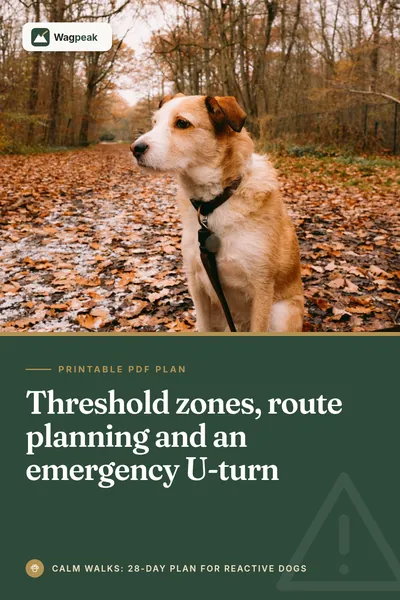
- Management first: route planning, timing, distance, emergency exits and kind equipment
- Core exercises: name game, hand target, look at that, 1-2-3 pattern walking, emergency U-turn, sniff breaks
- Day-by-day 28-day plan with rest days, plus a routine for surprise encounters and off-leash dogs
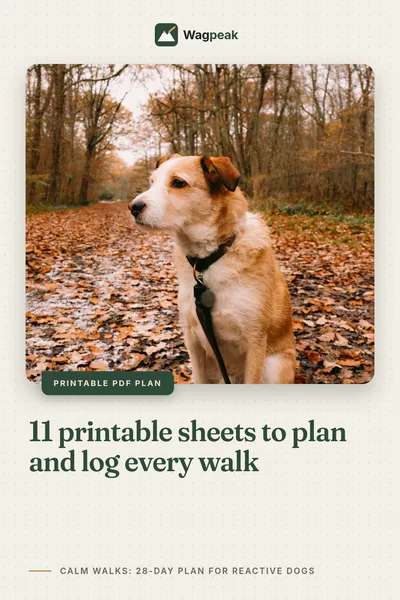
- 11 printables: trigger map and log, route planner, daily walk log, threshold tracker, 28-day checklist, emergency cards – A4, 31 pages
Reading your dog: green, yellow and red zones
Your dog almost always shows small signals before a big reaction: a hard stare, ears forward or pinned back, weight shifting onto the front legs, lip licking, or suddenly not taking treats. The guide splits the distance to a trigger into three zones. In green, your dog notices the trigger but can look away and take treats – this is where learning happens. In yellow, your dog is tense and stares, so you calmly add distance. In red, your dog barks, lunges or freezes and can't learn, so you leave quietly and help it recover.
The distances are different for every dog, every trigger and every day, so you watch your dog rather than counting metres.
Management first: routes, timing and distance
While you train, the plan keeps big reactions rare, because every reaction is a rehearsal of the behaviour you want to change. You pick two or three calm routes with wide paths and side streets, walk at quieter times, and know your emergency exits – side streets, driveways, gaps between parked cars. Crossing the road or walking in a curve around a trigger early, before your dog reaches the yellow zone, is the most useful thing you can do on any walk. Equipment should be comfortable and well fitted, never anything that works through pain, fear or startle.
Core exercises (look at that, U-turn, pattern walking)
Short sessions of two to five minutes, practised at home first, then on quiet walks, and only then near triggers: the name game, a hand target, “look at that” (your dog looks at a trigger from the green zone and gets a treat), 1-2-3 pattern walking, the emergency U-turn and sniff breaks with “find it”. The plan uses positive reinforcement only.
The 28-day plan
One short task a day, plus your normal calm walks, with a rest day and weekly review every seventh day. Week 1 is a reset with the foundations, week 2 takes the skills outside to a watching spot far from the path, week 3 starts “look at that”, and week 4 brings it into calm walks in real life. If a day goes badly, you repeat the day before: the plan is a guide, not a race, and no plan can guarantee that a dog will stop reacting.
11 printables
A trigger map, a trigger log, a “my dog's signals” sheet, a calm walk route planner, a daily walk log, a threshold distance tracker, a 28-day checklist (two pages), a weekly review, cut-out encounter emergency cards and notes for the vet or trainer.
FAQ
What is a reactive dog?
A dog who reacts more strongly than the situation needs – for example barking, lunging or freezing – when it sees triggers such as other dogs, people or bikes, usually on the leash. The reaction is a sign that the dog is overwhelmed in that moment, not stubbornness.
What should I do when my dog reacts on a walk?
Add distance and leave calmly. The guide's four-step routine is: breathe and loosen the leash, turn and go with your U-turn cue, feed once you have distance, then let your dog sniff and recover. Reading the green, yellow and red zones helps you step away earlier next time.
How long does reactive dog training take?
It varies a lot from dog to dog. The plan gives you a day-by-day structure for 28 days with rest days built in, and Day 28 ends with planning the next four weeks; many dogs need longer, and progress is rarely a straight line. If your dog has bitten, the reactions are getting worse or you're worried, talk to your vet or a qualified positive-reinforcement trainer or behaviourist.
What format is it?
A printable 31-page A4 PDF in English and Norwegian (both versions included), with 11 printables including a trigger map and log, route planner, daily walk log, threshold tracker, 28-day checklist and emergency cards, downloaded right after purchase. Nothing is shipped.

⭐ Best value
Calm Walks Pack: three plans, one price
Calm Walks + Loose-Leash Walking + Reliable Recall – 30 PDF files. $14 instead of $27 when bought separately.
30 PDFs: Calm Walks in English and Norwegian + Loose-Leash Walking and Reliable Recall in 14 languages each
Goes well with
Calm Walks Pack – save with the bundle: $14 instead of $27 · Loose leash walking – less pulling makes U-turns easier · Reliable recall in 14 days · Brain games for active dogs – enrichment at home on rest days
Calm Walks Pack: Reactive Dog Plan + Loose Leash + Recall
Reactive dog plan + loose leash + recall, 30 PDFs
$14 $27